At a glance
Call 119 for fire or an ambulance and 110 for the police; both are free from public phones. In an earthquake, protect your head and stay under a sturdy table until the shaking stops. Find your nearest evacuation shelter on your city's hazard map now, keep food and water for at least three days, and install a multilingual alert app.
- Last updated
- November 7, 2026
Rules, fees and services change often. Last checked: 7 November 2026. Always confirm with the official sources below or with your city office before you act.
Japan has many earthquakes, and also typhoons, heavy rain, floods and landslides. The government and cities send warnings quickly, often in several languages. What matters is that you know what to do before it happens.
Emergency numbers
- 119: fire, ambulance, medical emergency or injury.
- 110: police (crime, traffic accidents).
- 118: Japan Coast Guard (accidents at sea).
From a public phone these calls are free; no coins or card are needed. On phones with a red emergency button, lift the receiver, press the button, then dial.
How to call an ambulance (119)
- Dial 119. The operator asks “fire or ambulance?” Say “ambulance” (救急です, kyūkyū desu).
- Give the address or a nearby landmark.
- Say what happened, the symptoms and the person’s age.
- Give your name and phone number.
The Fire and Disaster Management Agency (FDMA) has an ambulance guide in 16 languages, including English, Vietnamese, Tagalog, Nepali, Indonesian and Burmese. Read it now, not during an emergency.
During an earthquake
- Indoors: protect your head from falling objects, get under a sturdy table, and stay there until the shaking stops.
- Outdoors: cover your head with a bag and move away from signboards, walls and windows that could fall.
- After the shaking: turn off gas stoves and heaters, put out small fires with an extinguisher, and do not light a fire because of possible gas leaks. Turn off the circuit breaker before you leave home.
- If buildings are damaged, or you are in a hilly area at risk of landslides, go to your evacuation shelter.
Japan measures shaking on a scale of 10 levels (0, 1, 2, 3, 4, 5-lower, 5-upper, 6-lower, 6-upper and 7). News reports use it (震度, shindo). An Earthquake Early Warning (緊急地震速報) is sent by TV, radio and mobile phone networks seconds before strong shaking arrives. When your phone sounds the alarm, protect yourself immediately.
Tsunami
If you feel a strong or long earthquake near the coast, go to high ground or a tall, sturdy building immediately. Do not wait until you see the wave, and do not believe that “the sea always goes out first”. Even if you felt no shaking, leave the coast or river mouth at once when a tsunami warning or an evacuation instruction is issued. On beaches, red-and-white checkered “tsunami flags” mean a tsunami warning or advisory.
Evacuation shelters
An evacuation shelter (避難所, hinanjo) is a school, community centre or other facility that the city opens in a disaster. Find yours now:
- Look at your city’s hazard map (on its website or at the city office). It shows flood, landslide and tsunami risk.
- Find the nearest shelter to your home, and to your workplace or school.
- Walk the route once, avoiding rivers, slopes and narrow streets.
- If going outside is more dangerous (for example in a flood), move to a sturdy building nearby or to the second floor or higher.
Alert levels and the new 2026 warnings
For heavy rain, floods and landslides, Japan uses five alert levels:
- Level 3: older people, people with disabilities, children and others who need time should start evacuating.
- Level 4: evacuation instruction. Everyone leaves the dangerous place.
- Level 5: a disaster is happening or about to happen. Take the safest action you can, right where you are.
New since May 2026: the Japan Meteorological Agency (JMA) now issues weather warnings with level numbers, for river flooding, heavy rain, landslides and storm surge. A Level 3 warning (警報), a new Level 4 danger warning (危険警報) and a Level 5 special warning (特別警報) match the evacuation levels above. If you hear “Level 4”, move to safety.
Emergency alerts and multilingual apps
- Earthquake Early Warnings and evacuation information are sent to mobile phones in the area, and broadcast on TV and radio.
- The free “Safety tips” app, introduced by the Japan National Tourism Organization (JNTO), pushes earthquake early warnings, tsunami warnings and weather warnings in 15 languages, including English, Vietnamese, Indonesian, Tagalog, Nepali, Thai, Khmer, Burmese and Mongolian. It is made for visitors but useful for residents.
- Your city may have its own disaster app, email list or social media account in English. Check its website.
A basic emergency kit
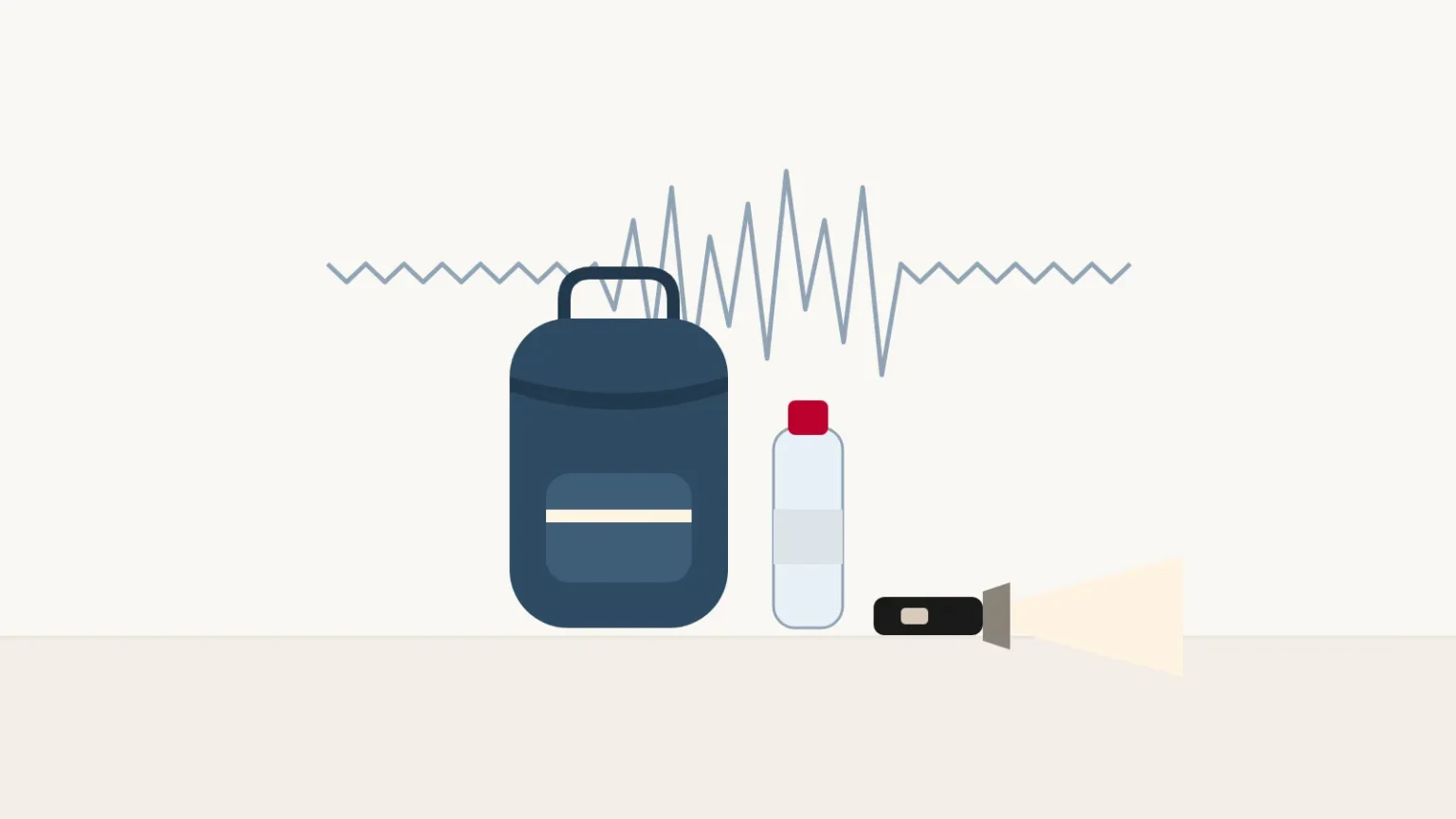
The ISA guidebook asks every household to keep a first-aid kit and enough food and water for at least three days, seven if possible, and to fix furniture so it cannot fall over. The Tokyo Metropolitan Government recommends “daily stockpiling”: keep a little more of the food and daily items you already use, use the oldest first, and replace them. Its stockpile leaflet lists:
- Water: 3 litres per person per day.
- Food and drink: rice or pre-packaged cooked rice, dry or instant noodles, canned food and fruit, retort meal pouches, drinks, vegetable juice, cheese or protein bars, snacks.
- Daily supplies: plastic bags, plastic wrap, aluminium foil, tissues, toilet paper, packing tape, work gloves, plastic gloves, face masks, wet wipes, a first-aid kit and household medicines.
- Items for when disaster strikes: a portable gas cooking stove and gas cartridges, emergency (portable) toilets, flashlights, an LED lantern, a head light, batteries, a hand-cranked rechargeable radio, mobile phone chargers and a backpack.
- If it applies to you: everyday medication, diapers and baby food for infants, items for older people, and sanitary products.
The right amounts depend on your household and home. The Tokyo Stockpile Navi website calculates them after a few questions, and Tokyo marks 19 November as “Stockpile Day” to check your supplies once a year.
Telling your family you are safe: 171
After a big disaster, phone lines get crowded. Dial 171 to record a voice message that your family can play back by dialling the same number and your phone number. There is also an online message board (web171) in English, Chinese, Korean and Japanese. Agree with your family in advance which number you will use.
Common mistakes
- Running outside during strong shaking. Falling glass and signs injure many people.
- Waiting to “see” a tsunami before leaving the coast.
- Not knowing your shelter until the disaster happens.
- Keeping no water at home.
- Ignoring an alert because it is in Japanese. Install a multilingual app now.
Learn the words on warning signs with our short notices reading lesson, and the safety words used at work with our workplace basics lesson.
Free help in your language. The Foreign Residents Support Center (FRESC) in Yotsuya, Tokyo, brings together government help desks for foreign residents. Its phone line is 0570-011000 (from some IP phones or from abroad: 03-5363-3013), weekdays 9:00 to 17:00. FRESC cannot process residence card procedures, but it can tell you where to go. Many cities also have their own foreign-resident help desk.
Frequently asked questions
Does the 119 operator speak English?
Do not count on it. Learn the key words (救急です, kyūkyū desu, and your address), read FDMA’s multilingual ambulance guide, and ask someone nearby to help.
Where is my evacuation shelter?
Your city shows shelters on its hazard map, on its website and at the city office. Check the one nearest your home, and the one nearest your workplace or school.
Can foreign residents use evacuation shelters?
Yes. The ISA guidebook tells foreign residents to go to the shelter designated by their local government when a disaster is likely or has happened.
What does Level 4 mean?
Everyone in a dangerous place must evacuate. Since May 2026, JMA’s new “danger warnings” carry Level 4 too. Do not wait for Level 5: by then a disaster is already happening.
My phone has no signal after an earthquake. How do I contact my family?
Try the 171 message dial or web171 when lines recover, and send short text messages instead of calls. Agree on a meeting place and a contact person with your family in advance.