At a glance
Garbage rules are set by each city: check your city's English guide and collection days the week you move in. Keep noise down, especially at night, and follow your rental contract. On trains, keep quiet and avoid phone calls. At work, be on time and report early. After-work drinking is optional, and you can say no politely.
- Last updated
- November 7, 2026
Rules, fees and services change often. Last checked: 7 November 2026. Always confirm with the official sources below or with your city office before you act.
Most problems between newcomers and neighbours in Japan are not about big things. They are about garbage put out on the wrong day, noise late at night, or not knowing an unwritten rule. This guide covers the rules that matter most, with official city guides as examples.
Garbage: every city has its own rules
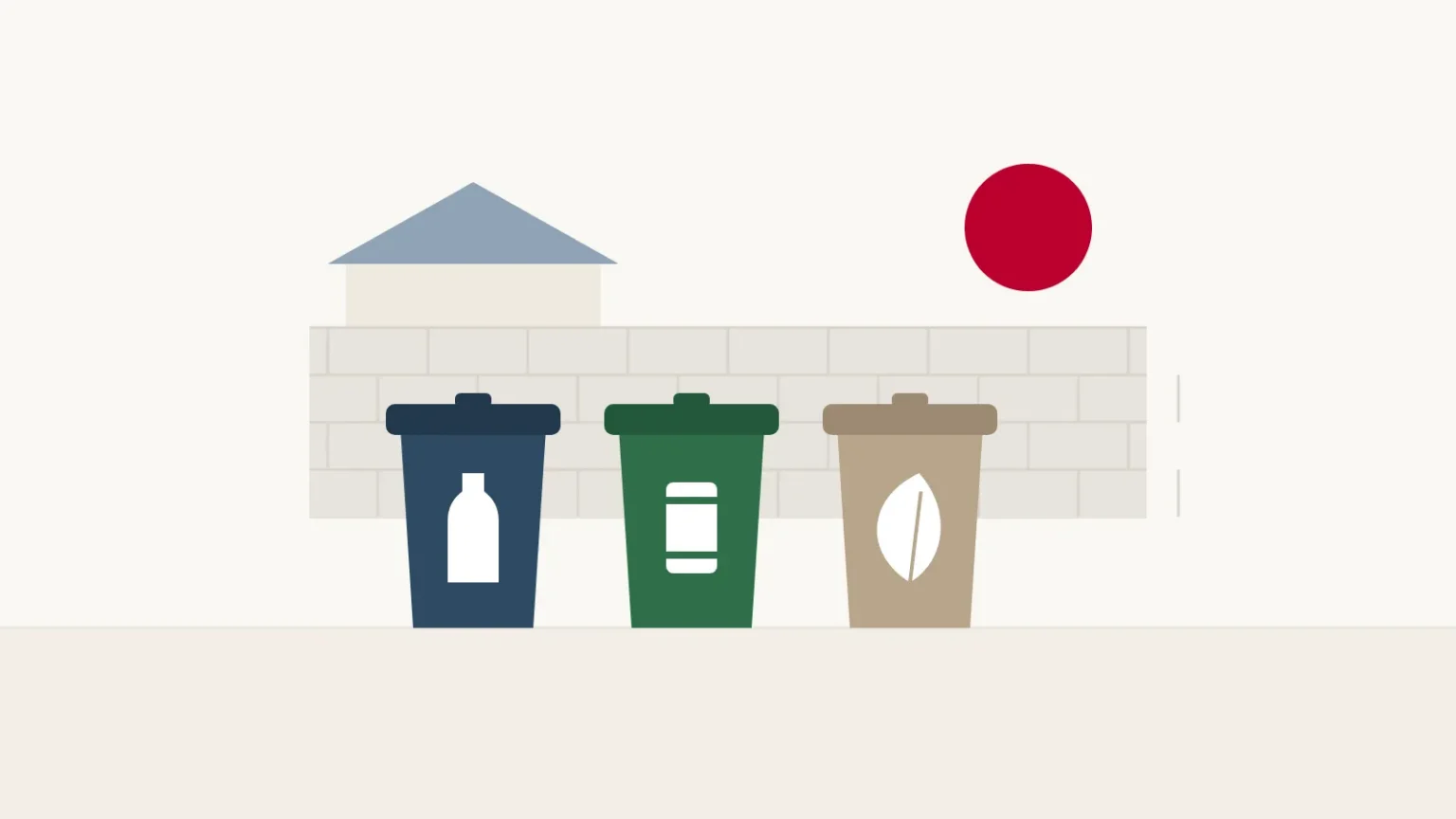
Garbage (ごみ, gomi) is collected by your city, and each city decides its own categories, bags and days. A rule that is correct in Tokyo may be wrong in Osaka. In your first week:
- Ask your landlord or agent where your building’s garbage point is and which days each type goes out.
- Get your city’s guide in English or your language. Many cities also have a sorting app.
- Put garbage out on the morning of collection day, before the set time, never the night before unless your building allows it.
- Use clear or semi-clear bags if your city asks for them, so collectors can see what is inside.
If garbage is not sorted correctly, it may be left behind with a warning sticker. Your neighbours will notice, and it often reaches the landlord.
Example: Shinjuku City, Tokyo
- Combustible garbage (可燃ごみ, kanen gomi): kitchen scraps, paper scraps, rubber and leather items, diapers — twice a week.
- Recyclable resources (資源, shigen): paper and cardboard, recyclable plastic, bottles, cans, PET bottles, and spray cans with dry-cell batteries — once a week, by 8 a.m. Rinse containers first.
- Metal, ceramics and glass (金属・陶器・ガラスごみ): small appliances, lighters, broken glass — twice a month. Wrap sharp items in thick paper and write “kiken” (dangerous).
- Oversized garbage (粗大ごみ, sodai gomi): items over 30 cm on any side, such as furniture or bicycles — by reservation, with a fee paid by sticker.
Example: Osaka City
- Household waste (普通ごみ, futsū gomi): kitchen scraps and items up to 30 cm — twice a week. No more than three 45-litre bags at a time.
- Recyclables, plastic containers, and old paper and clothes are collected separately, on their own days.
- Waste must be in a transparent or semi-transparent bag. Bags you cannot see into, cardboard boxes and paper bags are not collected.
- Collection times differ by area (a window of about two hours). Check the city’s Garbage Collection Map or the “San-āru” app.
- Collection can stop in typhoon-strength winds; the city posts a notice around 6 a.m.
Never put lithium-ion batteries, power banks or devices with built-in batteries in household garbage. Osaka City warns that they have caused fires in collection vehicles; Shinjuku collects small rechargeable batteries separately, with the terminals taped over. Air conditioners, TVs, fridges, freezers, washing machines and clothes dryers are not collected by the city at all: under the home appliance recycling law, the shop that sells you a new one, or the shop where you bought the old one, must take it back for a recycling fee.
Noise and neighbours
Japanese apartments, especially older wooden or light-steel buildings, carry sound easily. Shinjuku City’s guide for foreign residents lists the everyday noises neighbours complain about: conversations, TV and music, the kitchen, bath and toilet, washing machines and vacuum cleaners, footsteps in hallways and stairs at night, voices through open windows and doors closing. Noise late at night causes the most trouble.
- Keep music, calls and parties quiet, and avoid noisy chores such as laundry or vacuuming late at night.
- Close doors gently and walk softly on stairs at night.
- If friends visit, keep the volume low and say goodbye inside, not in the hallway.
- When you move in, it is customary to visit your next-door neighbours and greet them. A short よろしくお願いします (yoroshiku onegaishimasu) is enough.
Learn the greeting phrases in Greetings and introducing yourself.
Apartment rules
Your rental contract lists who may live in the apartment and what is forbidden. Shinjuku City warns that breaking these rules often leads to trouble with neighbours, and you may even be asked by the landlord to move out. The most common problems:
- More people living in the apartment than the contract allows, or letting friends use it.
- Keeping a pet where pets are not allowed (many buildings do not allow them).
- Leaving bicycles, shoes or boxes in the shared hallway or stairs.
- Breaking garbage rules.
Read your contract before you sign, and ask about anything you do not understand. See Finding an apartment in Japan.
On trains and buses
- Keep your voice low and do not talk on the phone. Set your phone to silent mode.
- Let people get off first, then board. Queue at the marked lines on the platform.
- Wear a large backpack on your front or put it on the rack when the train is crowded.
- Give priority seats to elderly people, pregnant women, people with disabilities and people with small children.
More in Trains and buses in Japan.
Workplace basics
Every workplace is different, but a few habits are expected almost everywhere:
- Be on time. Arrive a few minutes before your shift or meeting. If you will be late, call or message before the start time.
- Hō-ren-sō (報連相, hōrensō): 報告 (hōkoku, report), 連絡 (renraku, inform) and 相談 (sōdan, consult). Tell your supervisor about progress, problems and mistakes early, and ask before you decide something on your own.
- Greetings matter. おはようございます in the morning and お先に失礼します (osaki ni shitsurei shimasu) when you leave before others.
- Safety rules are not optional. On factory floors, building sites and in care work, follow every instruction and ask when unsure.
Practise these phrases in Workplace basics: greetings, safety and reporting.
After-work drinks (nomikai)
A 飲み会 (nomikai) is an after-work dinner with drinks. It is a chance to get to know colleagues, but outside working hours it is your choice. You can say no politely, for example すみません、今日は都合が悪いです (sumimasen, kyō wa tsugō ga warui desu, “Sorry, today doesn’t suit me”). You never have to drink alcohol: ask for tea or a soft drink. If you go, joining for the first part and leaving early is normal.
Since June 2020, employers in Japan must take measures against power harassment (since April 2022 for small and medium-sized companies too). If you feel pressured at work, the Ministry of Health, Labour and Welfare has a phone advice line for foreign workers in many languages, and the Tokyo Metropolitan Government publishes a Foreign Workers’ Handbook.
Common mistakes
- Using the garbage rules from your last city after you move.
- Putting garbage out the night before, where crows and cats tear the bags open.
- Throwing out a power bank or a phone with household garbage.
- Leaving a TV or fridge at the garbage point when moving out.
- Inviting friends to stay for weeks in an apartment rented for one person.
- Not telling your supervisor about a mistake until it becomes a big problem.
Japanese culture beyond the rules: read Japanese work culture and Onsen and sento etiquette.
Frequently asked questions
Where do I find my garbage collection days?
Ask your landlord or agent, and get your city’s guide or app. Osaka City, for example, shows collection times on its Garbage Collection Map and the “San-āru” app. Shinjuku City publishes an English guide and the “3R” app.
Can I put garbage out the night before?
Usually not. Cities ask you to put it out on the morning of collection day, before the set time (8 a.m. in Shinjuku). Follow your building’s rules if they say otherwise.
How do I throw away a fridge or a TV?
Not with city garbage. Under the home appliance recycling law, ask the shop that sells you a new one, or the shop where you bought the old one, to take it back. You pay a recycling fee.
Do I have to go to after-work drinking parties?
No. After-work drinks outside working hours are your choice, and you never have to drink alcohol. A polite “today doesn’t suit me” is fine.
What is hō-ren-sō?
報連相 means report, inform and consult. Japanese supervisors expect you to share progress, problems and mistakes early, and to ask before deciding alone.