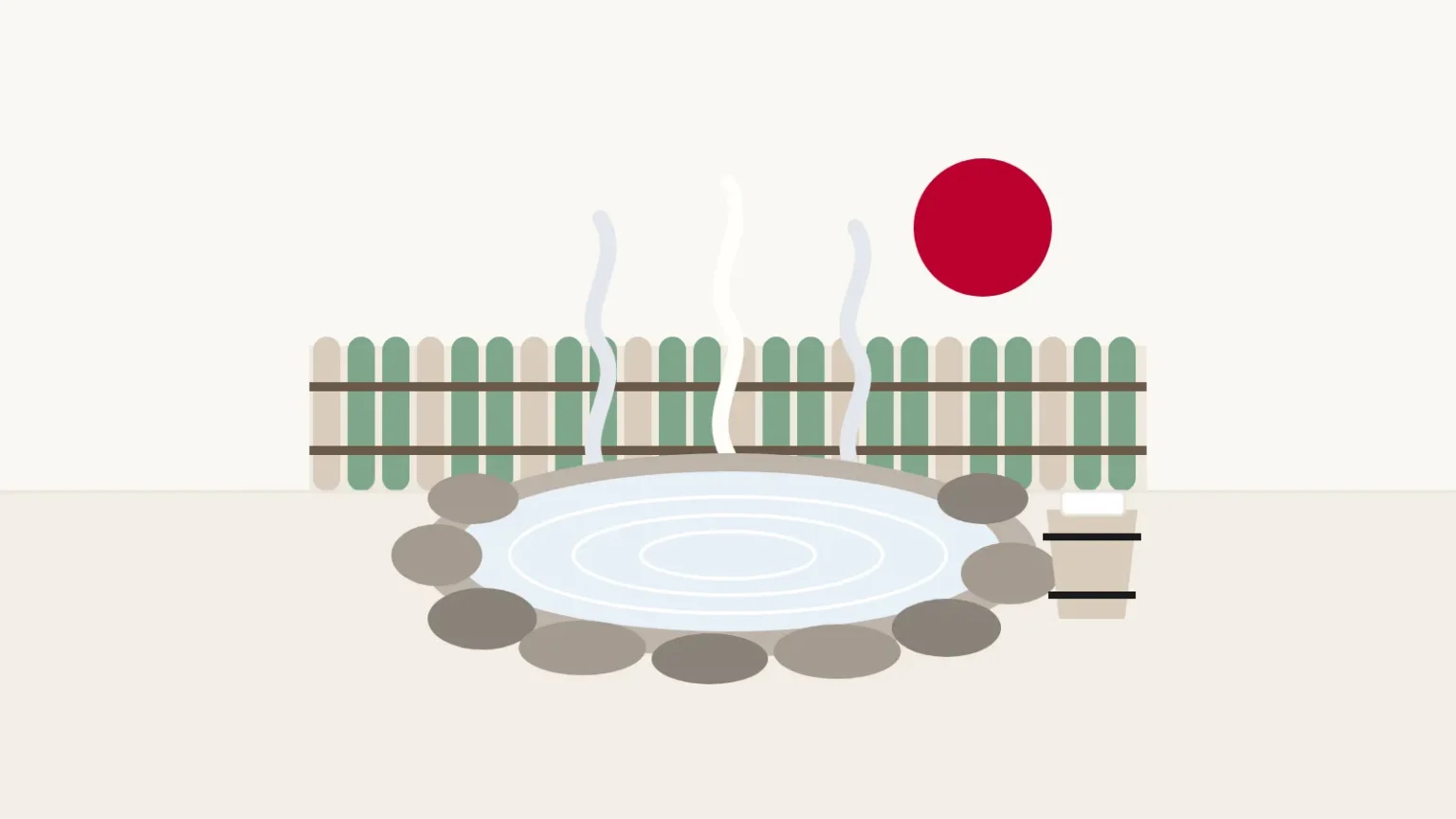
Japan’s bathing culture is one of the most relaxing parts of life here. A 温泉 (onsen) uses natural hot spring water; a 銭湯 (sentō) is a neighbourhood public bathhouse with heated tap water. Both have the same basic rules. Follow them and nobody will mind that you are new.
Onsen or sento?
- Onsen: natural hot spring water, often in resort towns, inns (旅館, ryokan) or day-trip bath facilities. Prices are set by each facility.
- Sento: a local bathhouse for daily use. In Tokyo, the Metropolitan Government sets the maximum price an ordinary sento may charge; from 1 August 2026 it is ¥600 for adults (12 and over), ¥200 for children aged 6 to 11 and ¥100 for children under 6.
- Super sento: larger facilities with many baths and saunas, at a higher price.
Baths are separated by gender. Look for the curtains (のれん, noren): 男 (otoko, men) is often blue and 女 (onna, women) is often red, but always read the character, because colours can change.
What to bring
- A small towel for washing and a larger towel for drying. Sento and many onsen also sell or rent them.
- Shampoo and soap if the bath does not provide them (many sento do not).
- A hair tie if you have long hair.
- Coins for lockers or a hair dryer at some sento.
- Water to drink afterwards.
Step by step
- Take off your shoes at the entrance and put them in a shoe locker.
- Pay at the counter or ticket machine, then go through the curtain for your gender.
- In the changing room (脱衣所, datsuijo), undress completely. Swimwear is not worn. Put your clothes in a basket or locker. You may carry the small towel for modesty.
- In the bathing area, sit at a washing station. Wash your body and hair with soap and shampoo, and rinse off completely, so no soap goes into the bath.
- Pour hot water over yourself before you get in (かけ湯, kakeyu), starting with your hands and feet, so your body gets used to the heat.
- Get into the bath slowly. Keep the small towel out of the water: fold it on your head or put it on the side.
- Tie up or cover long hair so it does not touch the water. Do not swim, splash or wash clothes in the bath.
- Come out if you feel too hot or dizzy, and drink water.
- Before you go back to the changing room, wipe off water with your small towel so you do not drip on the floor.
Stay safe in hot water
The Ministry of the Environment’s bathing precautions for hot springs say:
- Do not bathe immediately before or after eating, or after drinking alcohol. Bathing while drunk is dangerous.
- Drink enough water before and after bathing to avoid dehydration.
- Do not bathe if you are very tired or unwell. Staying in too long can harm your health.
- Older people, and people with high blood pressure, heart disease or a past stroke, should avoid water of 42°C or hotter.
Tattoos
Many onsen and some sento have refused people with tattoos. This is changing, but policies still differ by facility.
In March 2016, the Japan Tourism Agency told the hotel, inn and hot spring associations that refusing a bath only because someone has a tattoo is not appropriate. It reminded facilities that people have tattoos for religious, cultural and fashion reasons and that tattoos cause no hygiene problem, and it suggested options: covering a tattoo with a sticker or sheet, not asking anything for small tattoos (for example palm-sized), suggesting quieter times, or offering a private bath. MHLW passed the notice to local governments.
- Check the facility’s website or ask before you go. Look for “tattoo OK” (タトゥーOK) information.
- Cover a small tattoo with a cover sheet if the facility asks for it.
- Book a private bath (貸切風呂, kashikiri-buro) or a room with its own bath at an inn.
- Follow the staff’s decision politely, even if another facility had a different rule.
If you prefer privacy
Bathing nude with others is normal in Japan, but not everyone is comfortable with it, including for religious reasons. A private bath, a room with its own bath, or a quieter time of day are good choices. See Living as a Muslim in Japan for more on modesty and daily life.
Useful words
- 男湯 (otoko-yu) — men’s bath; 女湯 (onna-yu) — women’s bath.
- 露天風呂 (rotenburo) — outdoor bath.
- サウナ (sauna) and 水風呂 (mizuburo, cold plunge bath).
- タオル (taoru) — towel; 貸しタオル (kashi-taoru) — rental towel.
Practise katakana words like these in Katakana for loanwords.
Sources
All sources were checked on 7 November 2026. Dates, prices and rules change, so check the latest information before you go.
- JNTO — How to best enjoy Japan’s onsen: bathing manners and tips (English) — checked 7 Nov 2026
- JNTO — Understanding Japanese manners and etiquette (English) — checked 7 Nov 2026
- Ministry of the Environment — Multilingual manual for hot spring areas, incl. bathing precautions in English (PDF, 2021) — checked 7 Nov 2026
- MHLW — Notice forwarding the Japan Tourism Agency guidance on bathing by visitors with tattoos, 16 March 2016 (Japanese PDF) — checked 7 Nov 2026
- Bunkyo City (Tokyo) — Tokyo public bath prices from 1 August 2026: adults ¥600 (Japanese) — checked 7 Nov 2026