Japan marks the year with its seasons. Neighbourhood festivals, flower viewing and the summer Obon holiday are some of the best ways to meet people and feel at home. This calendar shows what happens when, with dates from official sources, and how to join in politely.
What is a matsuri?
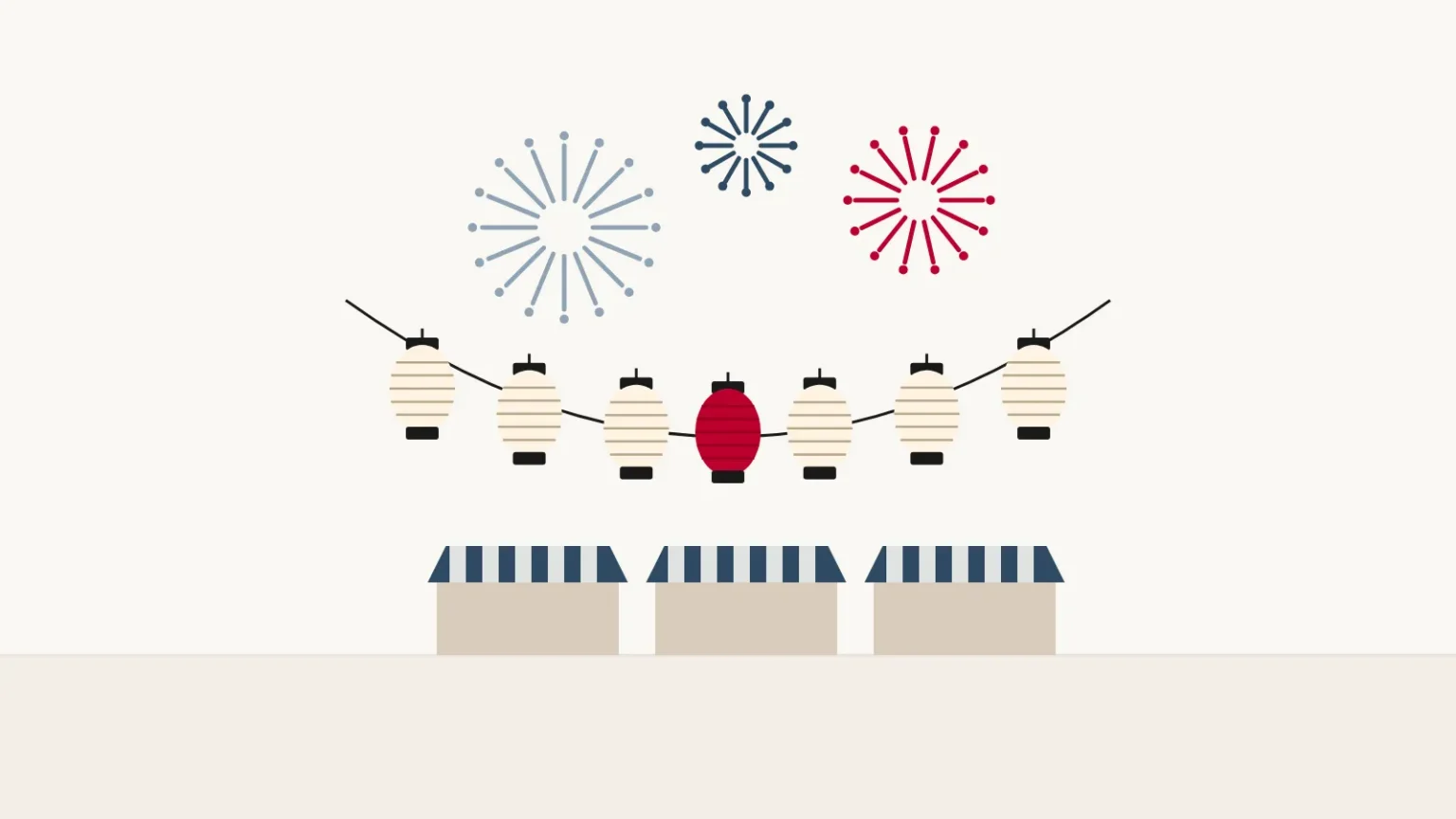
A 祭り (matsuri) is a festival, usually linked to a local shrine or temple. Small neighbourhood festivals often have food stalls (屋台, yatai), drums and a portable shrine (神輿, mikoshi) carried through the streets. Big festivals draw visitors from all over Japan, but the small ones near your home are often the easiest to enjoy. Watch for posters at your station, shrine or community notice board.
Winter: New Year and Setsubun
The year begins with お正月 (oshōgatsu), the New Year holidays. Many people make their first shrine or temple visit of the year, 初詣 (hatsumōde), in the first days of January. Read more in our article Japanese New Year (oshōgatsu).
In early February comes 節分 (setsubun), the day before the traditional start of spring. Families throw roasted soybeans and shout 鬼は外、福は内 (oni wa soto, fuku wa uchi, “demons out, good luck in”). Many shrines and temples hold bean-throwing events.
Spring: cherry blossoms and Golden Week
Cherry blossom viewing (花見, hanami) means picnics under the trees with friends or colleagues. The Japan Meteorological Agency records when the cherry trees open in each city. Its 30-year normal dates show how the season moves north:
| City | Normal flowering date |
|---|---|
| Naha (Okinawa, a different early cherry) | 16 January |
| Fukuoka | 22 March |
| Tokyo | 24 March |
| Nagoya | 24 March |
| Kyoto | 26 March |
| Osaka | 27 March |
| Sapporo | 1 May |
The actual date changes every year: in 2026, Tokyo’s trees opened on 19 March. Full bloom usually follows about a week later: JMA’s normal full-bloom date is 31 March in Tokyo and 4 April in Kyoto and Osaka. The petals fall soon after, so watch the forecast.
From late April to early May, several national holidays fall close together. This is Golden Week. In 2027 the holidays are 29 April (Showa Day) and 3, 4 and 5 May. Trains, flights and hotels are crowded and more expensive.
Summer: matsuri, Obon and fireworks
Summer is the high season for festivals. Many people wear a light cotton kimono, a 浴衣 (yukata), to festivals and fireworks displays (花火大会, hanabi taikai). July and August are the peak months for fireworks.
Obon (お盆, obon) is the summer period, typically between 13 and 16 August, when families remember their ancestors. People return to their family homes and join community dances (盆踊り, bon odori). Seats on planes, trains and highway buses sell out early, so book ahead if you travel then. Obon is not a national holiday, but many companies close for a few days; Mountain Day, 11 August, is a holiday.
Some famous summer festivals with fixed dates, as listed by JNTO:
- Aomori Nebuta Matsuri — 2 to 7 August: giant lit-up floats.
- Akita Kanto Matsuri — 3 to 6 August: tall poles of lanterns balanced by performers.
- Sendai Tanabata — 6 to 8 August: streets hung with paper decorations.
- Kyoto Gozan Okuribi — 16 August: huge bonfires on the hills mark the end of Obon.
- Nagaoka fireworks (Niigata) — 2 and 3 August.
Kyoto’s Gion Matsuri fills the whole of July, with its float parades in the middle and later part of the month.
Autumn: red leaves and harvest festivals
Autumn leaf viewing (紅葉狩り, momijigari) is the quieter twin of hanami. The colour arrives first in Hokkaido and the mountains, and last in the big southern cities. JMA records the day the leaves of a sample maple tree in each city have mostly turned red. Its normal dates, worked out from the 2025 observations and their difference from normal, are about 28 October in Sapporo, 28 November in Tokyo, 1 December in Osaka and Fukuoka, and 5 December in Kyoto. Parks and mountains near you may be earlier.
Many local shrines hold autumn festivals to give thanks for the harvest. In November, families take children aged three, five and seven to a shrine for 七五三 (shichi-go-san), around 15 November.
The year at a glance
| Month | What happens |
|---|---|
| January | New Year holidays and 初詣 (hatsumōde). 1 January and Coming of Age Day (11 January 2027) are national holidays. |
| February | 節分 (setsubun) bean throwing in early February. 11 and 23 February are national holidays. |
| March–April | Cherry blossoms, from late March in most big cities. 21 March is the spring equinox holiday (22 March is the substitute holiday in 2027). |
| May | Golden Week: 29 April and 3–5 May. |
| July | Kyoto Gion Matsuri all month; fireworks season starts. Marine Day: 19 July 2027. |
| August | Obon (about 13–16 August), bon odori dances, Nebuta, Kanto and Sendai Tanabata. Mountain Day: 11 August. |
| September–October | Autumn shrine festivals. Respect for the Aged Day (20 September 2027), autumn equinox (23 September), Sports Day (11 October 2027). |
| November–December | Autumn leaves, shichi-go-san, then year-end. Culture Day (3 November) and Labour Thanksgiving Day (23 November). |
Festival manners
- Take your garbage home or use the festival’s own bins. Many festivals sort garbage just like your city does.
- Do not touch a portable shrine or float, or join a dance group, unless you are invited.
- At a shrine, bow before you pass under the gate (鳥居, torii) and follow the signs for where to walk.
- In crowds, follow the staff and police directions, especially at fireworks displays and on station platforms.
- Ask before taking close-up photos of people, especially children.
- At hanami, follow the park’s rules: some parks limit alcohol, barbecues or reserving spaces.
Learn to read dates and days of the week in Time and dates.
Sources
All sources were checked on 7 November 2026. Dates, prices and rules change, so check the latest information before you go.
- JNTO — Japanese festivals and events (English) — checked 7 Nov 2026
- JNTO — Japan in August: Obon, summer festivals and fireworks (English) — checked 7 Nov 2026
- Japan Meteorological Agency — Cherry blossom flowering dates by city, with 1991–2020 normals (Japanese) — checked 7 Nov 2026
- Japan Meteorological Agency — Cherry blossom full-bloom dates by city, with 1991–2020 normals (Japanese) — checked 7 Nov 2026
- Japan Meteorological Agency — Maple leaf colouring dates 2025–2026 and difference from normal (Japanese) — checked 7 Nov 2026
- Cabinet Office — National holidays in 2026 and 2027 (Japanese) — checked 7 Nov 2026
- JNTO — Understanding Japanese manners and etiquette (English) — checked 7 Nov 2026