At a glance
Renting in Japan usually costs about 4 to 7 months' rent at the start, according to the MLIT guidebook. That covers the deposit, key money in some regions, an agency fee within one month's rent, insurance and the first rent. Most landlords want a guarantor or a rent guarantee company. Read the contract and the move-out rules before you sign.
- Last updated
- November 7, 2026
Rules, fees and services change often. Last checked: 7 November 2026. Always confirm with the official sources below or with your city office before you act.
Most people in Japan rent from private landlords through a real estate agent (不動産屋, fudōsan-ya). Contracts are usually for two years, and costs at the start are high compared with many countries. The Ministry of Land, Infrastructure, Transport and Tourism (MLIT) publishes a free Apartment Search Guidebook in 14 languages, including English, Nepali, Vietnamese, Indonesian, Tagalog and Myanmar. This guide summarises it.
How renting works, step by step
- Decide your budget, area and must-haves (distance to work or school, size, pets).
- Visit an agent. Take your residence card or passport, as you may fill in an application that day. You may be asked if you have a guarantor.
- View the apartment with the agent. Viewing is free, and you do not have to apply.
- Apply. A guarantor or a rent guarantee company is usually needed. The landlord or agent then checks your application.
- Listen to the important-points explanation (重要事項説明). The agent must explain the contract before you sign.
- Sign the contract and pay the initial costs, usually in cash or by bank transfer.
- Get the keys and move in. Within 14 days, report your address at the city office (see our first 14 days guide). Set up electricity, gas and water yourself.
Initial costs
MLIT gives a rule of thumb of 4 to 7 months’ rent in total, depending on the region and the property:
- Security deposit (敷金, shikikin): a safeguard against unpaid rent and repairs, usually about 2 months’ rent. It is returned when you leave, minus the cost of restoring damage you caused.
- Key money (礼金, reikin): a payment to the landlord that is not returned. It is common in the Kanto region (Tokyo area), usually 1 or 2 months’ rent. Some apartments have none.
- Non-refundable restoration fee (敷引き, shikibiki): a part of the deposit fixed in advance that you will not get back. MLIT says it is common in the Tokai and Kansai regions (including Osaka) and Kyushu.
- Agency fee: paid to the real estate agent, set within one month’s rent.
- Rent in advance: in Japan, rent is paid for the next month. If you move in mid-month, that month’s rent is usually prorated.
- Common service (management) fee: monthly, for shared areas, paid with the rent.
- Damage insurance: usually required, covering fire and water damage you might cause.
- Guarantee fee, if you use a guarantee company (see below).
Ask the agent for a written list of every cost before you apply. Also check whether there is a renewal fee (更新料) every two years, and whether an application fee is refunded if the contract does not go ahead.
Guarantors and rent guarantee companies
A guarantor (保証人, hoshōnin) pays your rent or repair costs if you do not. Guarantors must have a certain income, and you may need their proof of income and seal registration certificate. Most new arrivals do not have one, so landlords often ask you to use a rent guarantee company (保証会社, hoshō gaisha) instead.
MLIT says the guarantee fee is often 35% to 50% of one month’s rent, paid in advance for two years. It is not insurance: if the company pays rent for you, it will bill you for it. MLIT’s guidebook also lists a support system that makes it easier for schools to act as guarantors for international students, so students should ask their school.
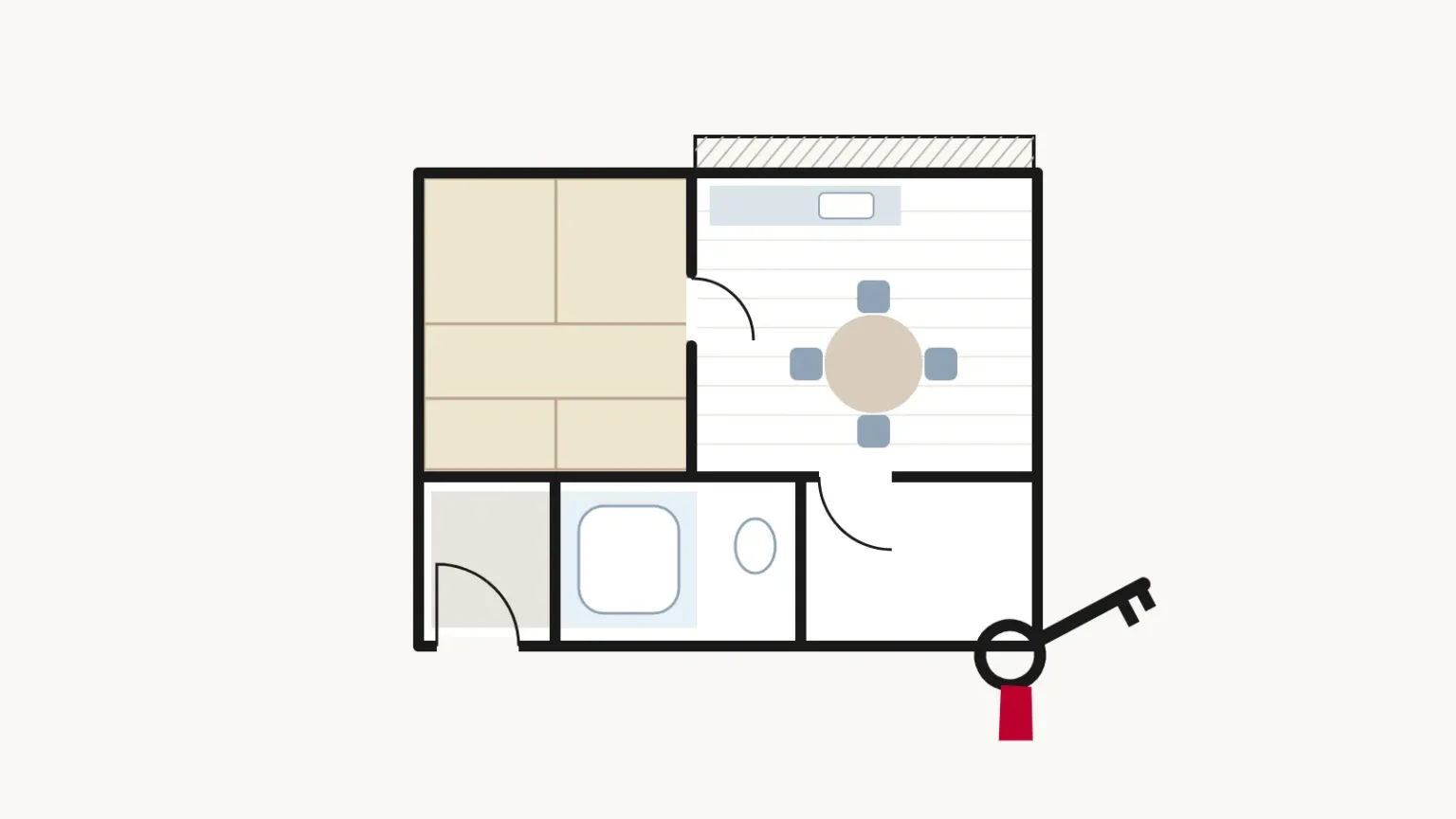
Reading a floor plan: 1K, 1DK, 1LDK
Japanese listings describe the layout with a number and letters (間取り, madori):
- The number is how many separate rooms there are, besides the kitchen area.
- K = kitchen, DK = dining-kitchen in one room, LDK = living, dining and kitchen in one room.
- 1K: one room plus a kitchen area. 1DK: one room plus a dining-kitchen. 1LDK: one room plus a living-dining-kitchen. 2LDK: two rooms plus an LDK.
- Room sizes are often given in 畳 (jō, tatami mats). “Western-style room” means a room with a normal floor; “Japanese-style room” has tatami.
Public housing and UR housing
- Public housing is run by prefectures and cities at lower rents for people on low incomes. Foreign residents may have extra conditions, such as a period of stay of more than a year. Ask the prefecture or city.
- UR rental housing is run by the Urban Renaissance Agency. It has a minimum income rule. Foreign residents can rent if they are mid- to long-term residents (including permanent residents). Ask a UR sales office.
Share houses
In a share house you rent a private room and share the kitchen and bathroom. Contracts, deposits and house rules are set by each operator, so read them as carefully as an apartment contract. Before you sign, check that you can register the address at the city office, what is included in the monthly price, and how much notice you must give to leave.
Foreigner-friendly help
- MLIT’s Guide to Looking for a Home lists websites of real estate agents that offer service in foreign languages.
- The Apartment Search Guidebook includes check sheets in several languages: what you want, how much you can pay at the start, and a list of the documents you have (passport, residence card, proof of income, employment or student certificate).
- Some prefectures and cities run programmes that introduce agents who help foreign residents. Ask your city’s foreign-resident help desk.
- Your employer or school may have company housing, dormitories or a partner agent. Ask them first.
Moving out
Give written notice within the period in your contract, usually 1 to 2 months before. Take everything with you, including rubbish. The landlord or agent checks the room with you and compares it with the condition when you moved in. You pay for damage or dirt you caused on purpose or through carelessness, and that cost is taken from your deposit. Before you leave Japan, also file the moving-out notification at the city office.
Common mistakes
- Signing before you understand the important-points explanation. Ask questions, or bring someone who reads Japanese.
- Not taking photos of the room on move-in day. Photos help when the deposit is settled.
- Letting a friend move in without telling the landlord. Unreported co-occupants can be a reason for eviction.
- Forgetting that the guarantee company will bill you for any rent it paid.
- Leaving furniture or rubbish behind when you move out.
Listings use katakana for many words (mansion, auto-lock). Our katakana for loanwords lesson helps, and numbers and prices helps with rent and fees.
Frequently asked questions
How much money do I need to rent an apartment?
MLIT’s rule of thumb is about 4 to 7 months’ rent for the initial costs, plus moving and furniture. Ask the agent for the exact total in writing for the apartment you want.
Do I get my deposit back?
In principle yes, minus the cost of restoring damage you caused and anything you left behind. Key money and any fixed non-refundable part (敷引き) are not returned.
I have no guarantor. Can I still rent?
Usually yes, by using a rent guarantee company. It charges a fee, often 35% to 50% of one month’s rent for two years. Students can ask their school about guarantee schemes.
What is the difference between 1K and 1LDK?
1K is one room plus a kitchen area. 1LDK is one room plus a separate living, dining and kitchen room, so it is bigger and usually more expensive.
Can a landlord refuse me because I am a foreigner?
Some landlords do. Try agents that serve foreign residents (see MLIT’s Guide to Looking for a Home), and ask your employer, school or city help desk. If you are treated unfairly, the human rights counselling office at FRESC can advise you.